Follow Bob Bosisto and Pete Roseveare as we go birding and ringing in Cornwall and beyond.....
Tuesday, 25 June 2019
'Greenish' Warbler at Porth Joke
I thought I would share my photographs of the Greenish Warbler at Porth Joke on June 9th found by Steve Rowe on his local patch . I was happy with the ID whilst watching it however suspicions have been raised on Social Media from birders I have a lot of respect for (regarding Green Warbler) and who would have more experience than me on Leaf Warblers so I thought I would share all the photographs I took for everyone's benefit. All photographs are unedited and uncropped.
Friday, 12 April 2019
The African Pied Crow in Cornwall
Going to see the Pied Crow at Lands End yesterday inspired me to do some research about the species and write about this eye catching corvid.
African Pied Crow in Cornwall
Widely spread over Sub-Saharan Africa this conspicuous
corvid with white collar and breast contrasting with overall black plumage was
first seen in Britain at Spurn Point; East Yorkshire in June 2018. After it was
seen in Norfolk it journeyed over 300km to Clevedon, Somerset on 26th
June. It’s next port of call was the village of St Justinian Pembrokeshire in
July 2018 before heading back to the east coast village of Flamborough spending
the winter of 2018 settled at this site. In 2019 after a prolonged stay at
Flamborough the bird moved down the coast to Sussex before making another long-distance
journey to West Penwith (first of all seen flying along the coast at Cot
Valley) before settling at Lands End on 10th April.
The east coast arrival and subsequent urge to head west is
rather interesting behaviour and could be seen as a natural reaction typical of
a long distance or (perhaps more likely) ship assisted vagrant trying to
relocate. The status of Pied Crow in the Western Palearctic is also interesting
with birds now accepted as genuine vagrants in Morocco, Libya and Western
Sahara (attempted breeding even took place in this area in 2010). Evidence of
Pied Crow using ships to reach the Western Palearctic comes from Iberia and
notably Gran Canaria where three birds at Puerto De La Luz were found to have
originated from an oil rig that had been moored off of the Mauritanian
Coastline. Closer to home several sightings from Holland are thought to have involved
ship assisted birds. The corvid family seem prone to using ships as a means to
venture much further from their breeding range and even in some cases establish
new territories in new geographical areas. I’m reminded of the House Crow (originally
occurring in South East Asia) which has established colonies in Egypt and Israel
by means of this method and has reached Western Europe via ship with accepted
records from Holland (recorded since 1998) and Ireland (Cork 2010).
Whether we will know for sure the origins of the British
Pied Crow with any certainty is unlikely. Even if the bird was trapped and isotope
analysis of a dropped feather carried out this would now prove nothing as it
would have now completed a full moult in the UK. It does however seem that it
is a very rare and desirable cage bird which is not easily available. I decided
to take a look at how easy they are to buy as a pet and it would appear that
they aren’t at all. A website in America offers hand fed babies at a staggering
$3500 each whilst in the UK they simply don’t seem to be available at present.
Somebody from the UK enquiring on a forum as to whether it was a good idea to
have one as a pet only had responses from U.S.A telling them to look for a
cheaper and easier alternative.
![]() |
Photo courtesy of Steve Rogers
|
In the field I found the Pied Crow to be approachable yet
wary and no tamer than any other corvid at the complex. My experience with pet
corvids is limited but I do know that they can become amazingly tame and are
trained to mimic sounds and words. They will outgrow their natural behaviour
very quickly due to their intelligence which cannot be retrained.
![]() |
| Photo courtesy of Steve Rogers |
In conclusion my own theory would suggest that this bird is
of ship assisted origin but I would be happy to learn from any more information
that may be out there. I’m sure that many of our true mega rarities in the UK
are ship assisted without us knowing. For instance, many Nearctic passerines
may well have come off of a boat you only need to look at where they turn up. Personally,
I think it should be fine to count them regardless as the bird is still wild
and has just used its survival instincts which I think is pretty special.
Thanks to Kester Wilson and an interesting article on Birdguides by Sam Viles for some of my facts and ideas. Also Crows and Jays by Madge & Bunn.
Wednesday, 2 January 2019
New Years Day CBWPS Green Bird Race
A day of car free birding around our local parish and a race
to see how many birds me and Libbie could see in 24hours
| Yellowhammers seem to have a healthy population where I live we saw 14 during the day |
At only just past midnight whilst most people were probably
out celebrating me and Libbie had just got ready for bed and could hear a Song
Thrush that had been woken up by the local firework display , the first bird of
2019! Our bird list for the day was underway but we soon drifted off to sleep
in readiness for an early start ( although I did wake up at 5:30am to the sound
of a Pheasant calling away)
Well before dawn we were up and ready and heading out at
7:15am and although it was pitch black a Golden Plover flew over calling just
above my house and as we headed over to the local farm we were delighted to
hear both Barn Owl and Tawny Owl , a great start! Soon some passerines started
to stir from their slumbers and Libbie heard a Robin singing and a Crow calling
from the copse. A snipe flew over and as the sun came up a group of
Yellowhammers flew out from their roost. We headed home for Breakfast and to
help my Mum for an hour or so but that didn’t stop us adding more birds to the
list!
With the feeders topped up we enjoyed seeing Coal Tit ,
Chaffinch , Great Spotted Woodpecker and Starling and also whilst I fed my pets
a Bullfinch flew over calling and some House Sparrows were busy eying up the
chicken feed.
Now was time to set off for our marathon walk all around the
local area and what a brilliant day we had! All the birds seemed to be so showy
and we had some nice surprises of some scarce birds for the local area. Our
first visit was to the local village pond where we saw a Canada Goose as Goldfinches
fed in the Alders and Libbie had her first views of a stunning male Bullfinch.
We then headed to the local sewage works enjoying a few Common Chiffchaffs and a
very showy Dipper for Libbie. We carried on across farmland and fields adding a
solitary Skylark and a surprise group of 10 Fieldfare, whilst ten Buzzards
gluided together over a Pheasant Farm. | The Countryside around my house is very good for woodland birds with lots of mature tree's |
![]() |
| The local pond has an excellent small reedbed- even Bittern has been seen here in the past |
After a brief encounter with the New Years Day Hunt in the
middle of a wet valley with trumpets blowing and hounds everywhere ( why do these
things happen to me when I am out birding!) we arrived in the hamlet of
Talskiddy. Birds seemed to be everywhere with Redwings and Starlings filling
the fields and a Marsh Tit on a garden birdfeeder being a highlight. We soon arrived
at the local pond which is always an excellent place to Birdwatch and our gave
our only chance of some waterbirds. Two Cormorants were a good local record and
a Moorhen , 2 Mallard and a Grey Heron were good padders for the list. The real
highlight ( especially for Libbie) were 4 very showy Water Rails feeding on the
flattened reed bed. Time was beginning to run out so we stomped up to Trewan
Hall ( a local Manor House ) and scanned the mature tree’s. Luck was again on
our side as two Great Spotted Woodpecker, at least 4 Nuthatch , 1 Treecreeper
and a Mistle Thrush all showed well. As the light began to fade we positioned
ourselves overlooking the valley behind my house hoping for a Woodcock , sadly
nothing was doing but a flyby Common Gull going to roost and 3 Roe Deer more
than made up for it.
We walked 8 miles and saw 55 species of birds as well as
many different tree’s, plants and fungi. It just goes to show that sometimes
the best place to visit for nature are right on your doorstep….
Birds: Woodpigeon , 2 Stock Dove, Collared Dove, 6 Great Spotted Woodpecker, Jay, Magpie,Raven, Rook, Carrion Crow, Jackdaw, Long-tailed Tit, 2 Marsh Tit, Coal Tit, Great Tit, Blue Tit, 4 Nuthatch, Treecreeper, Robin, Pied Wagtail, Grey Wagtail, 120 Meadow Pipit, Skylark, 1 Golden Plover, 1 Barn Owl, 1 Tawny Owl, 1 Dipper, 10 Fieldfare, 60 Redwing, 20 Song Thrush, Blackbird, 3 Cormorant, Mistle Thrush, Common Gull, Black-headed Gull, Herring Gull, Goldfinch, Chaffinch, Chaffinch, Bullfinch, House Sparrow, Dunnock, 14 Yellowhammer, Starling, 3 Chifffchaff, Goldcrest, Wren, Canada Goose, Mallard, Common Snipe, Grey Heron, Moorhen, 4 Water Rail, Pheasant, 6 Red-legged Partridge, Buzzard, Feral Pigeon
Fungi: Candle Snuff Fungus, Yellow Brain Fungus
Mammals: Rabbit, Roe Deer
Wild Flowers: Greater Periwinkle, White Ramping Fumitory, Common Polypody, Male Fern, Petty Spurge, Nipplewort, Red Campion, Gorse, Ivy, Bramble, Nettle, Navelwort, Snowdrop, Bracken, Broom, Hartstongue, Travellers Joy, Junkus, Rhodedendren, Buddleia, Daisy, Chickweed, Buttercup, Ribwort Plantain, Greater Plantain, Winer Heliotrope, Hogweed, Tutsan, Acanthus, Herb Robert, Phragmites Reed, Camilla Japonica, Primrose, Black Bryony, Broad Leaved Dock, Bulrush, Section Ruderalia.
Tree's: Turkey Oak, Beech, Holly, Hazel, Ash, Elder, Sycamore, Bay Willow, English Oak, Blackthorn, Alder, Horse Chesnut, Cotoneaster, Silver Birch, Holm Oak, Field Maple, European Larch, Sweet Chesnut, Weeping Willow, Apple , Monkey Puzzle, Cornish Elm.
Birds: Woodpigeon , 2 Stock Dove, Collared Dove, 6 Great Spotted Woodpecker, Jay, Magpie,Raven, Rook, Carrion Crow, Jackdaw, Long-tailed Tit, 2 Marsh Tit, Coal Tit, Great Tit, Blue Tit, 4 Nuthatch, Treecreeper, Robin, Pied Wagtail, Grey Wagtail, 120 Meadow Pipit, Skylark, 1 Golden Plover, 1 Barn Owl, 1 Tawny Owl, 1 Dipper, 10 Fieldfare, 60 Redwing, 20 Song Thrush, Blackbird, 3 Cormorant, Mistle Thrush, Common Gull, Black-headed Gull, Herring Gull, Goldfinch, Chaffinch, Chaffinch, Bullfinch, House Sparrow, Dunnock, 14 Yellowhammer, Starling, 3 Chifffchaff, Goldcrest, Wren, Canada Goose, Mallard, Common Snipe, Grey Heron, Moorhen, 4 Water Rail, Pheasant, 6 Red-legged Partridge, Buzzard, Feral Pigeon
![]() |
| Yellow Brain Fungus |
Fungi: Candle Snuff Fungus, Yellow Brain Fungus
Mammals: Rabbit, Roe Deer
Wild Flowers: Greater Periwinkle, White Ramping Fumitory, Common Polypody, Male Fern, Petty Spurge, Nipplewort, Red Campion, Gorse, Ivy, Bramble, Nettle, Navelwort, Snowdrop, Bracken, Broom, Hartstongue, Travellers Joy, Junkus, Rhodedendren, Buddleia, Daisy, Chickweed, Buttercup, Ribwort Plantain, Greater Plantain, Winer Heliotrope, Hogweed, Tutsan, Acanthus, Herb Robert, Phragmites Reed, Camilla Japonica, Primrose, Black Bryony, Broad Leaved Dock, Bulrush, Section Ruderalia.
Tree's: Turkey Oak, Beech, Holly, Hazel, Ash, Elder, Sycamore, Bay Willow, English Oak, Blackthorn, Alder, Horse Chesnut, Cotoneaster, Silver Birch, Holm Oak, Field Maple, European Larch, Sweet Chesnut, Weeping Willow, Apple , Monkey Puzzle, Cornish Elm.
Friday, 28 December 2018
Curlew Country Offspring Visit Cornwall
You know birding and ringing have many directions in this day and age and I love the pace! So many different avenues you can pursue and so many surprises can be had in this modern age of internet, mobile phones and social media. From large county and national year lists to worldwide birding and ringing opportunities at the click of a mouse button! Yet yesterday I had an encounter that bought some nostalgia and emotion that I have not truly experienced for a long time and made me reflect on why I choose to get up so early in the mornings and devote so many hours watching and monitoring the birds of Cornwall and beyond!
At Hayle Estuary located near West Cornwall I found a colour ringed Curlew. As many regular readers of this blog will know colour ring reading is a passion of mine and I never tire of the thrill of finding out where so many of our species originate from. I have had some surprises in the past of long distance migrations and I have also learnt an awful lot of the origins and lifestyles of many of our birds. Waders are normally the most fascinating of them all and can be from just about anywhere in the world!
![]() |
| The un-seasonal bright sun made photographing the colour ringed Curlew (at the back) very difficult! |
It was great to get such a fast response from Tony Cross of the Curlew Country project informing me that it was the first ever recovery of one of there captive reared birds released in Shropshire! It was originally released at Stiperstones
National Nature Reserve on 20th July 2018, yesterday it was located nearly 200 miles away in a flock of roughly 100 other (non-ringed) Curlews at Hayle Estuary.
I was thrilled and decided to take a look at the project and find out why they had decided to captive rear Curlew.
I must admit that I am guilty of glazing over many posts found on social media and online forums asking for help or headlining as the next species we might lose and fear I had done the same with this one! Sounds harsh but it is so frequent now that I feel many projects get lost in the doom and gloom of an ever increasing plea for help and money! Each year the RSPB and BTO seem to be asking for help for a never ending stream of species and get caught up in red tape and bureaucracy and for me the practical element often seems lame when compared with the money raised. Now don't get me wrong I am not criticising the organisations, they must have so many employees that go home emotionally drained, contemplating the future of our wildlife and wonder if it would be far more effective to by a gun and dispatch the decision makers of this country! I am also aware of the many success stories that this country has witnessed and the people who are responsible for these conclusions deserve to be triumphant victors in such times of turmoil! So, with that in mind it was refreshing to see the approach taken by the Curlew Project team. I whole-heartdly feel that the approach they are taking is a pioneering one and is the key to making a real difference moving forward!
Local communities, society's and organisations could be the saviour of so many species if given the right structure and instruction to work with. A worrying rift between the farming community and the environmental sector ( I use the term loosely) has formed in recent years, some difference of opinions are always going to be there as that is the nature of the beast. However, I live in a rural community and know that most farmers or people that rely on the countryside for their living are as concerned as the birders amongst us for the welfare of our natural world.
The Curlew Country website has a brilliant short film capturing the relationship between a retired farmer and the Curlew that use his farm and I would urge you to watch it here: Keeper of the Call Film
Tony Cross stated near the end of the film that this is merely putting a band aid on a wound that needs greater attention! That is the real dilemma and one that seems to be harder than ever to put right. But with the correct relationships and education I hope that the future will see the correct decisions being made and the chance for strong recoveries for many species in the UK.
For more information on the Curlew Country Project or to find out how you can make a donation please visit the following website: https://curlewcountry.org/
Sunday, 2 December 2018
Nanjizal Niceties
Last Sunday morning was my last trip to ring at Nanjizal for 2018. Always a bit gutting to think that the season is over but having caught just 18 new birds it felt right that the nets will be packed away for the winter months.
My ringing schedule in the County seems to work quite well. I am spoilt really as I have the opportunity to regularly ring at Nanjizal which is a fantastic migration route. But I also have my own regular patch, the Goss Moor which is one of the best locations in Cornwall for breeding species. I try to help out at Nanjizal a bit in the Spring and also do some ringing on the Goss Moor for the early returning migrants. I then switch my attention fully to the Goss Moor through the summer months to monitor the breeding species that reside there in June and July and into August. As Autumn kicks off the Goss Moor quietens down allowing me to once again turn my attention to assisting Kester Wilson at Nanjizal were large numbers of common migrants get ringed each season. As of today it is back to thinking about whats about on the Goss Moor and local vicinity's for the winter period! But not before some personal reflection on my encounters at Nanjizal this year!
To find out more about the numbers and sightings at the is the exceptional place; I urge you to read the regularly updated blog found here: https://nanjizalbirds.wordpress.com/
Ringing in Cornwall during the Spring months is exciting and rewarding. It always throws up a good bird or two and my year started well at Nanjizal with two Wood Warblers in April. They are sadly very scarce in the county nowadays with only a handful of records each year and have not bred since 2000. So to get two on the same morning was most welcome!
![]() |
| One of two Wood Warblers ringed and processed at Nanjizal in April, 2018. |
As more migrants started to arrive my attention turned to the Goss Moor once again. However a trip to the Valley on the 3rd of June did produce a Spotted Flycatcher which likely attempted to breed on site. Another bird that is becoming a much rarer breeder in Cornwall!
![]() |
| A likely breeding bird! |
I did not return much to Nanjizal until the middle of August as the Goss Moor kept me out of mischief. However, amongst the large volume of passage migrants a "goodie" or two was lurking! On the 22nd I had my first taste of a local rarity in the form of a pristine Nightingale! An exceptional year for this species at Nanjizal and also in the county with at least 7 reports that I am aware of! They obviously bred well somewhere. The morning also produced my first Pied Flycatcher of the year which are always delightful to see.
![]() |
| Nightingale is a very rare bird in Cornwall nowadays |
![]() |
| Pied Flycatcher seemed to be passing through Cornwall in reasonable numbers during 2018. |
The rest of the month seemed a bit of a blur and large numbers of common Warblers and migrants were processed as the weather permitted. Amongst them was a real splash of varied colours and species!
![]() |
| Kingfishers seemed to be found at the site on a daily basis. |
![]() |
| As were Grey Wagtails |
![]() |
| This Green Woodpecker was a nice surprise and only the 2nd to be ringed at Nanjizal. |
![]() |
| I was really chuffed to ring this Whinchat as it was the first I had ringed in the County! |
My biggest surprise happened on the 29th of August and will stay with me forever! I caught up with a lifer that I had longed and hoped for in Cornwall, especially being a ringer and regular at Nanjizal. After a reasonable morning for Sedge Warblers I was walking near a net that is set up for catching Locustella and Acrocephalus type warblers and contemplating how much longer I should carry on ringing as it had started to quieten down. My attention was drawn to a bird working its way through the low grass clumps and heading straight for the net. I held fire and watched as it flew out of the under growth and straight into the net and pocketed nicely. Naturally, I extracted the bird straight away suspecting another Sedge and was dumbfounded to see a large prominent gold central crown stripe! Finally, I had caught up with an Aquatic Warbler. I would have happily hung up my ringing pliers that day and gone out on a high, safe to say I was ecstatic!
![]() |
| Aquatic Warbler is one of the rarest breeding Passerines in the Western Palearctic making this encounter even more rewarding! |
Kester recently updated that the annual total of birds ringed at Nanjizal during 2018 ended on 9082! Included were Blackcap 2843, Sedge Warbler 1648, Chiffchaff 946, Willow Warbler 602, Whitethroat 574, Grasshopper Warbler 139, Nightingale 6, Yellow-browed Warbler 16! Rarities were Melodious, Marsh and Aquatic Warbler. Iberian Chiffchaff x 2, Wood Warbler x 2, Red-breasted Flycatcher, Little Bunting x 3, Hoopoe, Wryneck, and a Spotted Crake!
It wasn't just the nets that produced for me. Due to the location of the valley it also has a consistent stream of flyover migrants and over the course of the year I also encountered Ortolan Bunting, Richards Pipit, Serin, Glossy Ibis, Common Crane, Dotterel and Turtle Dove, that's just the ones that I nailed and many more probables and possibles have been relinquished to the back of my mind!
I know you shouldn't wish your life away but I am already excited about the prospects of next years visits to Nanjizal and what they might bring.
Wednesday, 14 November 2018
Pied Wheatear and Sincerest Apologises
Let me start with my personal sincerest apologies! When Bob and I started this blog we promised ourselves that we would update it regularly and try our darnedest to keep it as interesting as possible. Sadly, due to commitments beyond our control it has fallen by the wayside. I have started writing many posts and then not been able to return to them and the moment has passed and the entries forgotten!
In a bid to thwart this trend my plan is to start writing about our surreal year from now and work backwards to a point that I feel we are up to date once again.
14th of November - Pied Wheatear at Trevose Head
| Pied Wheatear relocated at Trevose Headland |
On the 10th of November pictures of a Pied Wheatear were published on a Facebook page. The person posting was well known to me and I strongly suspected that the bird was or had been in a local vicinity! I informed other local birders of my suspicions and the day after a handful of hopefuls went on the hunt around the Trevose Head area located near Padstow, sadly to no avail and it seemed that the opportunity to see such a local rarity was lost. After some more racking of locals brains it transpired that the bird was indeed located at Trevose Golf Course and due to it being on private inaccessible grounds was suppressed! A sad fact, but understandable.
Late yesterday evening I received an anonymous tip off that the bird had relocated to an area that was public and the bird seemed in good health and settled! Unsure what to believe I called Bob and hatched a plan to drag him away from his new found play pet (he has a real living girlfriend now), and to meet me at first light near the location to sort fact from fiction. I was a little early and it was still quite dark at the time but decided to get into position anyway. A short while later I heard some commotion from the road beneath me! It was Bob on his way up getting a barrage of abuse from the ex county recorder who sadly for many reasons unknown to me has become an avid suppressor and regards the National Trust headland his own private birding site! A difficult situation as for many years he was a firm friend and a fantastic teacher that turned both Bob and I into adequate birders. Sadly the suppression and competitive nature was too much and we both independently decided that such selfish acts were no longer for us and distanced ourselves from the foolery! It is nice to be able to see other peoples birds nowadays and occasionally turn something else up to share with others, but that is a story for another time.
Thankfully Bob managed to make a break for it and head on up to the location we had been given. Albeit, was closely followed by the angry suppressor. We quickly hatched a plan! Knowing that I was so far unscathed from the verbal obscenity we agreed that if Bob moved forward and located the bird I could be his buffer and between us we could relocate the bird and whoever was not suffering from the torrents of abuse could then slope off and get news out as far and wide as was possible!
Bugger me the plan worked! We both got on the bird prior to the Suppressor Chiefs arrival and had good but brief views of the bird. I then tailed back a few meters whilst Bob went ahead and out of site to get the news out. A short while later Bob returned to the relaxing tranquil Cornish headland sounds of personal abuse and swear words and he was just in time as I was getting close to boiling point and today's twitching fraternity would have been greeted with a fantastic rare bird and a corpse!
Our deed was done and we both needed to get going as work was beckoning! It was superb to get so many messages and calls today thanking us for the news and effort and it made me realise what a great local and national birding community we all have the pleasure of being involved with!
| It was nice to see the bird managing to get plenty of quality local produce inside it! |
I do not miss the old days when I wasn't allowed to tell anybody about anything and I often feel regret about the birds that so many people would have enjoyed if given the chance. At least things are different now! As a side note Trevose Head is now owned by the National Trust and is a amazing birding location with a superb track record that would rival any location in Cornwall. It can produce in all weathers as the sea-watching is phenomenal and so is the chance of just about anything else turning up. Have it on your radars!
| A bird that I will remember for a longtime for various reasons! |
Sunday, 10 June 2018
Learning To Ring Birds
My New Year’s resolution for 2018 was to begin the long
journey into learning how to ring birds. I had been out with Pete (who already
has a ringing permit) on a number of occasions in the last 18 months and the
ringing had really captured my imagination. Not only do you get to see birds in
a whole new light but you are able to
contribute to many surveys across the country and most interestingly for me is
how you are able to learn about migration and discover where birds travel to on
migration and how long birds live for. I also hope in the future to be able to
travel around the world and volunteer at the many bird observatories in Europe
and beyond once I have my permit.
| This Wood Warbler at Nanjizal was a stunning bird, in the hand the long primaries are very evident, a feauture worth checking for in the field |
The first step into the world of ringing is to obtain a ‘T
Permit ‘(a trainee ringing permit that allows you to handle birds and apply
rings whilst being accompanied and mentored by a qualified trainer.) and also, I
had to contact somebody who was willing to train me. I felt so grateful and privileged
when I contacted Kester Wilson and he was more than happy to be my trainer and
I also had the added bonus that Pete is also able to help me train (as he has a
helper’s endorsement on his licence). Staying within Cornwall to learn was a real
added bonus for my travelling and also ringing within the county is more
interesting to me so it was a great start all round!
Annoyingly for me though was the terrible start to the year
for weather we had in the South West. It seemed every time I had a day off of
work it was blowing a gale and raining (meaning you can’t set nets as it would
be too risky for the birds) and even when we got nearer to Spring we had the
big freeze! So again, no chances to ring as it was just too cold for the birds
to attempt any ringing so I spent my evenings reading through the ringer’s
manual (the BTO rulebook for ringing) and learning as much as I could before I
started.
![]()
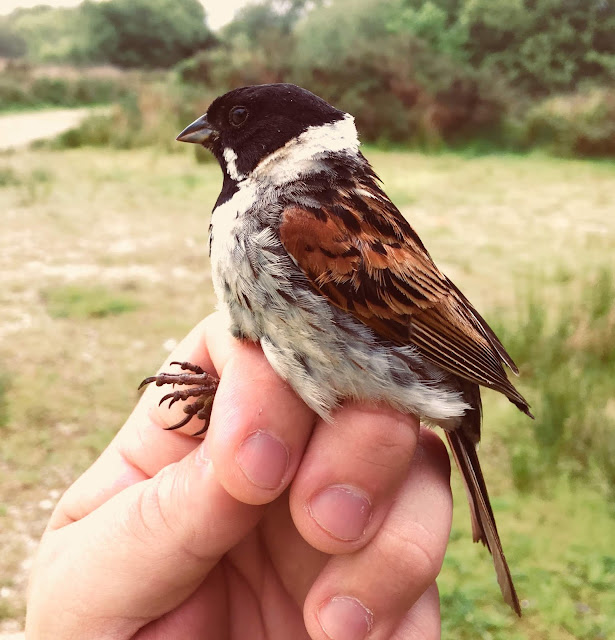
Reed Bunting- Plenty of pairs seem to be doing well on the Goss Moor
|
Finally as April set in the weather started to change and at
last I was heading to Nanjizal in the far west of Cornwall. Nanjizal Valley is
Kester’s ringing site and through years of careful management he has created a
paradise for migrant birds and an awesome ringing site which catches in my
opinion nationally important numbers of migrant birds as they arrive from
Africa in the Spring or as they depart Britain in the Autumn. Although it is an
hours drive away for me (which means leaving my house before 5am to get there
for first light!) I feel a special connection with this area of Cornwall as it
is where my family originate from, I even drive my car along Bosistow Lane and
park it at Bosistow Farm to get to Nanjizal! On my first morning I mainly
watched the others and helped take notes of all the details of each bird but I
was elated to ring my first two birds! A Bullfinch and a Great Tit.
As mid- May approached it is usually the time to pay more attention to breeding birds and as a ringer you can learn a great deal about how successful breeding has been and also, I think it is the most accurate way of surveying an area for breeding birds as more birds end up in a net than you could ever possibly see or hear whilst surveying on foot. So now was the perfect time to join Pete and assist him with his Constant Effort Site on the Goss Moor Nature Reserve near Indian Queens. The Goss Moor is a huge scrubby area of land which happens to be perfect breeding habitat for many summer visitors such as Warblers and Cuckoo’s but also some scarce resident breeding birds such as the nationally threatened Willow Tit. In the summer months Pete contributes to a National breeding Survey when he rings on his Constant Effort Site; an area of land with nets set up in exactly the same place each time, which is visited 12 times during the breeding season at exactly the same time each year. This builds up an amazingly detailed picture of how the birds are faring each year nationally and helps ornithologists build a picture as to what is happening to the birds and how well they are doing in the whole country, it really is a great idea! So far this year I’ve had some fantastic mornings with Pete and have again learnt so much thanks to him and have again seen some wonderful species but worryingly it seems that this year our birdlife is struggling more than usual. Many migrant birds have not arrived in any numbers and quite a few are in poor condition, possibly due to the very late spring we have had. Also, our resident birds such as Robins, Wrens, Goldcrests and various Tits seemed to have disappeared from large areas of the moor. I suspect that sadly many succumbed to the very harsh weather we had in February and March when the freezing conditions would have made it very difficult to survive. Birds however are very resilient and it will be interesting to see how they will do during the rest of the breeding season and already we are seeing signs of improvement since the warm spell of weather we have had with the first youngsters emerging from their nests in recent days.
![]() |
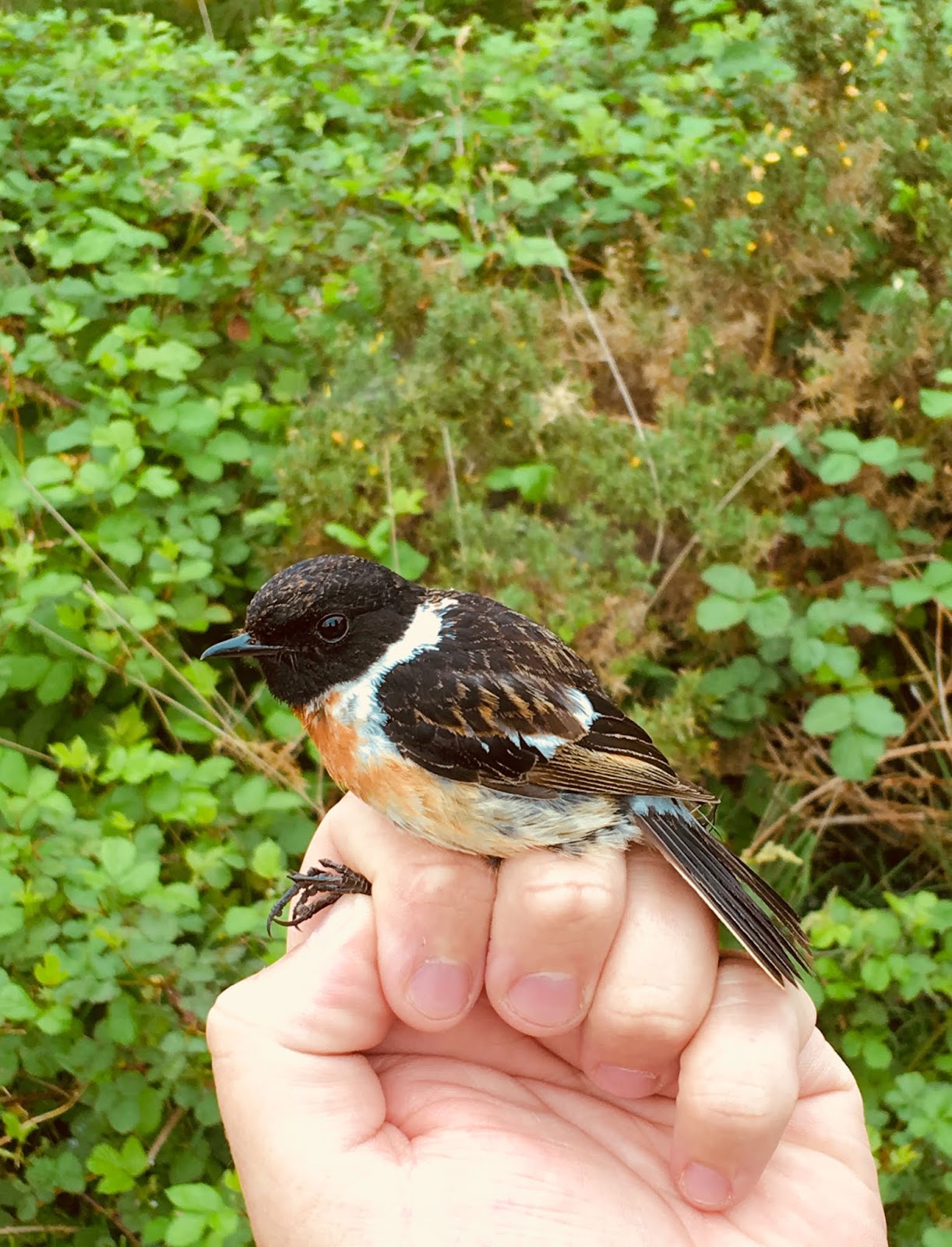
| This smart male Stonechat survived the cold winter and went on to breed successfully with one chick fledging and surviving into adulthood |
The beginning of my training has been a real eye opener for me,
learning to be a bird ringer takes a lot of commitment and is a tough skill to
master! Rightfully there are a lot of measures put into place before you are
allowed a permit of your own but there is no rush for me as every time I go out
I learn something new or I become more confident when handling birds and understanding
how to identify and age each species in the hand. It’s fair to say that apart from
the sleep deprivation (I get up at 4:30am in the summer!) I am enjoying every
minute of it!
![]() |
| This Great Spotted Woodpecker was brilliant to see up close, however it drilled a nice hole into my thumb as you can see on the picture! |
I’d like to say a big thankyou
to Kester Wilson, Pete Roseveare, Mark Grantham, Robbie Philips, Jake and John
Ryan for all of their help and company of the last few months.
Subscribe to:
Posts (Atom)