Showing posts with label Ringing. Show all posts

Friday, 31 July 2020

North Cornwall Barn Owl Ringing 2020

As a licenced bird ringer it is imperative that I take a scientific approach and ensure that my activities are done with some validity and structure to ensure that the data that I obtain is of significant substance, either locally or nationally and in the ideal situation, both. I feel that in most instances I tick all the boxes; carrying out constant effort ringing in the summer months to monitor some of Cornwall’s breeding birds and also by helping out at the monumental site that is Nanjizal, where a large volume of migrating birds pass through each autumn. However, there is a particular species that I cannot help but get all doughy eyed over and feel immense privilege and joy when surveying.

The Barn Owl has to be one of the most iconic and loved birds of the British Isles and indeed further afield. Its ethereal presence has captivated the hearts and souls of so many Britons for centuries. Yet for such a captivating species it has undergone some worrying strife. In 1932 the British population of Barn Owls was estimated to be around 12,000 and even this was a substantial drop in numbers from what was once Britain's commonest owl. A further survey was undertaken between 1982-1985 and concluded that there were approximately 4500 pairs breeding in Britain. Seeing a further decline of 67%! This prompted it to be amber rated in the list of Birds of Conservation Concern having had a moderate (25-49%) decline in the UK breeding population or range over the previous 25 years. In addition, it was assigned a Schedule 1 status and special protection. Under the Wildlife and Countryside Act 1981 as amended by the Environmental Protection Act 1990, it is an offence, liable to special penalty, to intentionally disturb any wild bird included in the Schedule while it is building a nest or is in, on, or near a nest containing eggs or young or to disturb dependent young of such a bird. As with so many British birds, the main reason for decline seemed to be the decimation of natural nesting locations and the ever-changing countryside and suitable hunting habitat. Traditional sites in old farm buildings have also been lost as barns have been converted to other use including residential occupation or have simply been allowed to deteriorate until they collapsed or were demolished. 

It is important to monitor this species in order that the current population levels can be assessed to determine whether any further declines have occurred. West Cornwall Ringing Group participate in a national project that is coordinated by the British Trust for Ornithology to provide ongoing assessments of the UK Barn Owl population. Monitoring consists of a visit to the nest site by specially trained and licensed bird ringers in the breeding season, where details of occupancy rates, breeding performance and survival are recorded, and any young are ringed with uniquely numbered leg rings. To find out more about ringing in general please visit: BTO Ringing Scheme


2020 Monitoring Results 

Monitoring a north Cornwall Barn Owl Box.

Over 100 nest boxes are currently surveyed across Cornwall and I have slowly started to assist in growing the number of sites monitored in the north of the county. In 2020 a further 7 boxes were added to the North Cornwall monitoring list. Sadly due to the Covid-19 lock down I was unable to do any early monitoring, so egg clutch sizes were not recorded during this period. However, early brood sizes were obtained so I was still able to produce some important nest record data nonetheless. I was interested to compare this years data with last seasons and noted that the average brood size was very similar to that of 2019.     

Adults Ringed


A distinct lack of adults were processed during 2020 by me! This was partially down to the late initial checking dates but also some alteration was needed in the catching technique. However, I was pleased to add 2 adult females and an adult male to the scheme. I am hopeful that I might encounter these again in the future. 

Chicks Ringed


I had heard from other Owl ringers across the UK that it was going to be a pretty dire year for the productivity of the species as they were finding many nests unoccupied. However, Cornwall seemed to have bucked the trend and it appears we had a bumper crop of juvenile Barn Owls! Of the 10 boxes occupied 32 chicks were ringed. The largest clutch being 5, but the majority having clutches of 3 and 4 birds and all looking very health and likely to fledge. Interestingly, birds that chose to lay eggs later did not appear to be as successful; only producing 1 or 2 fledglings. This was most likely due to the atrocious weather we had here in Cornwall that was almost consistent through the whole of June!

I am looking forward to seeing how the Barn Owls fared across the rest of the county and indeed the rest of the UK during 2020. I know there are a couple of boxes with some breeding activity still occurring within Cornwall, but will be checking the ringing groups web page with regularity for the final outcome. If you wish to do the same then please keep an eye on here: West Cornwall Ringing Group

Over the past couple of seasons I have also had the upmost pleasure of attending many boxes with legendary photographer and naturalist Adrian Langdon. His photographic works speak volumes on his commitment and passion. Your eyes will be in for a real treat if you visit his blog spot found here: Images Naturally   

Lastly, it is always a real pleasure to witness the enthusiasm of those persons that grant permission for us to monitor boxes. There is none more so than those with cameras fitted to their boxes who get a real intimate showing of the trials and tribulations that the owls face. One of the nests that I monitor has such a device and it makes for some pretty addictive viewing. To watch how this family group has fared this year then please grab a hot beverage, put your feet up and take a look here: Mike and Molly the North Cornwall Barn Owls    

Sunday, 2 December 2018

Nanjizal Niceties

Last Sunday morning was my last trip to ring at Nanjizal for 2018. Always a bit gutting to think that the season is over but having caught just 18 new birds it felt right that the nets will be packed away for the winter months.

My ringing schedule in the County seems to work quite well. I am spoilt really as I have the opportunity to regularly ring at Nanjizal which is a fantastic migration route. But I also have my own regular patch, the Goss Moor which is one of the best locations in Cornwall for breeding species. I try to help out at Nanjizal a bit in the Spring and also do some ringing on the Goss Moor for the early returning migrants. I then switch my attention fully to the Goss Moor through the summer months to monitor the breeding species that reside there in June and July and into August. As Autumn kicks off the Goss Moor quietens down allowing me to once again turn my attention to assisting Kester Wilson at Nanjizal were large numbers of common migrants get ringed each season. As of today it is back to thinking about whats about on the Goss Moor and local vicinity's for the winter period! But not before some personal reflection on my encounters at Nanjizal this year! 

To find out more about the numbers and sightings at the is the exceptional place; I urge you to read the regularly updated blog found here: https://nanjizalbirds.wordpress.com/

Ringing in Cornwall during the Spring months is exciting and rewarding. It always throws up a good bird or two and my year started well at Nanjizal with two Wood Warblers in April. They are sadly very scarce in the county nowadays with only a handful of records each year and have not bred since 2000. So to get two on the same morning was most welcome! 


One of two Wood Warblers ringed and processed at Nanjizal in April, 2018.
As more migrants started to arrive my attention turned to the Goss Moor once again. However a trip to the Valley on the 3rd of June did produce a Spotted Flycatcher which likely attempted to breed on site. Another bird that is becoming a much rarer breeder in Cornwall!

A likely breeding bird! 
I did not return much to Nanjizal until the middle of August as the Goss Moor kept me out of mischief. However, amongst the large volume of passage migrants a "goodie" or two was lurking! On the 22nd I had my first taste of a local rarity in the form of a pristine Nightingale! An exceptional year for this species at Nanjizal and also in the county with at least 7 reports that I am aware of! They obviously bred well somewhere. The morning also produced my first Pied Flycatcher of the year which are always delightful to see. 

Nightingale is a very rare bird in Cornwall nowadays 


Pied Flycatcher seemed to be passing through Cornwall in reasonable numbers during 2018. 
The rest of the month seemed a bit of a blur and large numbers of common Warblers and migrants were processed as the weather permitted. Amongst them was a real splash of varied colours and species! 

Kingfishers seemed to be found at the site on a daily basis.

As were Grey Wagtails

This Green Woodpecker was a nice surprise and only the 2nd to be ringed at Nanjizal.

I was really chuffed to ring this Whinchat as it was the first I had ringed in the County! 
My biggest surprise happened on the 29th of August and will stay with me forever! I caught up with a lifer that I had longed and hoped for in Cornwall, especially being a ringer and regular at Nanjizal. After a reasonable morning for Sedge Warblers I was walking near a net that is set up for catching Locustella and Acrocephalus type warblers and contemplating how much longer I should carry on ringing as it had started to quieten down. My attention was drawn to a bird working its way through the low grass clumps and heading straight for the net. I held fire and watched as it flew out of the under growth and straight into the net and pocketed nicely. Naturally, I extracted the bird straight away suspecting another Sedge and was dumbfounded to see a large prominent gold central crown stripe! Finally, I had caught up with an Aquatic Warbler. I would have happily hung up my ringing pliers that day and gone out on a high, safe to say I was ecstatic! 


Aquatic Warbler is one of the rarest breeding Passerines in the Western Palearctic
making this encounter even more rewarding!
Kester recently updated that the annual total of birds ringed at Nanjizal during 2018 ended on 9082! Included were Blackcap 2843, Sedge Warbler 1648, Chiffchaff 946, Willow Warbler 602, Whitethroat 574, Grasshopper Warbler 139, Nightingale 6, Yellow-browed Warbler 16! Rarities were Melodious, Marsh and Aquatic Warbler. Iberian Chiffchaff x 2, Wood Warbler x 2, Red-breasted Flycatcher, Little Bunting x 3, Hoopoe, Wryneck, and a Spotted Crake!

It wasn't just the nets that produced for me. Due to the location of the valley it also has a consistent stream of flyover migrants and over the course of the year I also encountered Ortolan Bunting, Richards Pipit, Serin, Glossy Ibis, Common Crane, Dotterel and Turtle Dove, that's just the ones that I nailed and many more probables and possibles have been relinquished to the back of my mind!

I know you shouldn't wish your life away but I am already excited about the prospects of next years visits to Nanjizal and what they might bring.  


Sunday, 10 June 2018

Learning To Ring Birds


My New Year’s resolution for 2018 was to begin the long journey into learning how to ring birds. I had been out with Pete (who already has a ringing permit) on a number of occasions in the last 18 months and the ringing had really captured my imagination. Not only do you get to see birds in a  whole new light but you are able to contribute to many surveys across the country and most interestingly for me is how you are able to learn about migration and discover where birds travel to on migration and how long birds live for. I also hope in the future to be able to travel around the world and volunteer at the many bird observatories in Europe and beyond once I have my permit.


This Wood Warbler at Nanjizal was a stunning bird, in the hand the long primaries are very evident, a feauture worth checking for in the field 


The first step into the world of ringing is to obtain a ‘T Permit ‘(a trainee ringing permit that allows you to handle birds and apply rings whilst being accompanied and mentored by a qualified trainer.) and also, I had to contact somebody who was willing to train me. I felt so grateful and privileged when I contacted Kester Wilson and he was more than happy to be my trainer and I also had the added bonus that Pete is also able to help me train (as he has a helper’s endorsement on his licence). Staying within Cornwall to learn was a real added bonus for my travelling and also ringing within the county is more interesting to me so it was a great start all round!
This Northern Wheatear is an example of the Greenland race 'Leucorhoa' . This amazing bird will have wintered in Africa before travelling via Cornwall to breed in Greenland or perhaps even Northern Canada !Note the brown flecks on the mantle, warn plumage tones and in the hand it had particularly long primaries. 


Annoyingly for me though was the terrible start to the year for weather we had in the South West. It seemed every time I had a day off of work it was blowing a gale and raining (meaning you can’t set nets as it would be too risky for the birds) and even when we got nearer to Spring we had the big freeze! So again, no chances to ring as it was just too cold for the birds to attempt any ringing so I spent my evenings reading through the ringer’s manual (the BTO rulebook for ringing) and learning as much as I could before I started.


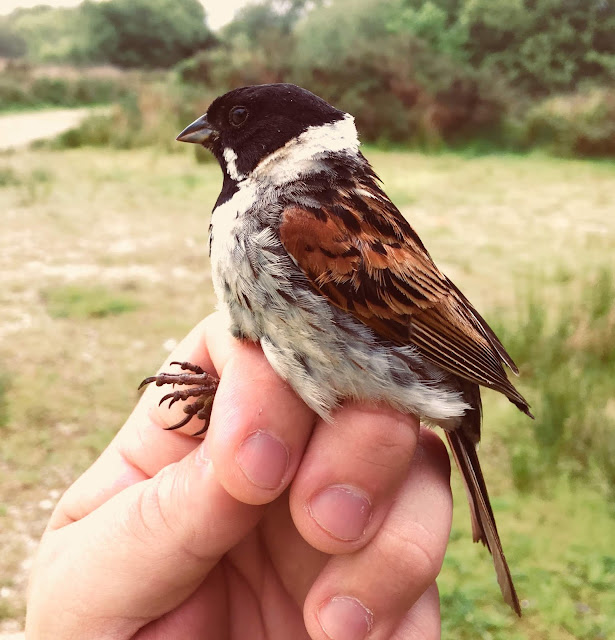
Reed Bunting- Plenty of pairs seem to be doing well on the Goss Moor


Finally as April set in the weather started to change and at last I was heading to Nanjizal in the far west of Cornwall. Nanjizal Valley is Kester’s ringing site and through years of careful management he has created a paradise for migrant birds and an awesome ringing site which catches in my opinion nationally important numbers of migrant birds as they arrive from Africa in the Spring or as they depart Britain in the Autumn. Although it is an hours drive away for me (which means leaving my house before 5am to get there for first light!) I feel a special connection with this area of Cornwall as it is where my family originate from, I even drive my car along Bosistow Lane and park it at Bosistow Farm to get to Nanjizal! On my first morning I mainly watched the others and helped take notes of all the details of each bird but I was elated to ring my first two birds! A Bullfinch and a Great Tit.


This Garden Warbler had been ringed by Pete last year in exactly the same hedgerow, in those 12 months it has travelled 8000 miles to winter in sub Saharan Africa and then return to Cornwall to breed, amazing!


I journeyed down to Nanjizal a further four times in the month and I learnt so much each time, I was even lucky enough to ring a Sparrowhawk on one occasion which was awesome! Plus, many migrant warblers including a Sedge Warbler that was at least 4 years old (meaning that it travelled… two and from Africa which I find mind blowing to be honest!). I was also lucky to be present when the ringing team processed two stunning Wood Warblers which are a very scarce migrant in Cornwall these days. I think because you spend so much time being sat or stood still when you are ringing you do also see and hear good birds from time to time and I was lucky enough to see Hoopoe, Marsh Harrier and hear Yellow Wagtails, Tree Pipits and Redpolls as they migrated through the valley.

This juvenile WIllow Tit at least proves there are still some pairs breeding successfully in Mid Cornwall. However the species seems to be declining. Hopefully further study can help save it from total collapse


As mid- May approached it is usually the time to pay more attention to breeding birds and as a ringer you can learn a great deal about how successful breeding has been and also, I think it is the most accurate way of surveying an area for breeding birds as more birds end up in a net than you could ever possibly see or hear whilst surveying on foot. So now was the perfect time to join Pete and assist him with his Constant Effort Site on the Goss Moor Nature Reserve near Indian Queens. The Goss Moor is a huge scrubby area of land which happens to be perfect breeding habitat for many summer visitors such as Warblers and Cuckoo’s but also some scarce resident breeding birds such as the nationally threatened Willow Tit.   In the summer months Pete contributes to a National breeding Survey when he rings on his Constant Effort Site; an area of land with nets set up in exactly the same place each time, which is visited 12 times during the breeding season at exactly the same time each year. This builds up an amazingly detailed picture of how the birds are faring each year nationally and helps ornithologists build a picture as to what is happening to the birds and how well they are doing in the whole country, it really is a great idea! So far this year I’ve had some fantastic mornings with Pete and have again learnt so much thanks to him and have again seen some wonderful species but worryingly it seems that this year our birdlife is struggling more than usual. Many migrant birds have not arrived in any numbers and quite a few are in poor condition, possibly due to the very late spring we have had. Also, our resident birds such as Robins, Wrens, Goldcrests and various Tits seemed to have disappeared from large areas of the moor. I suspect that sadly many succumbed to the very harsh weather we had in February and March when the freezing conditions would have made it very difficult to survive. Birds however are very resilient and it will be interesting to see how they will do during the rest of the breeding season and already we are seeing signs of improvement since the warm spell of weather we have had with the first youngsters emerging from their nests in recent days.

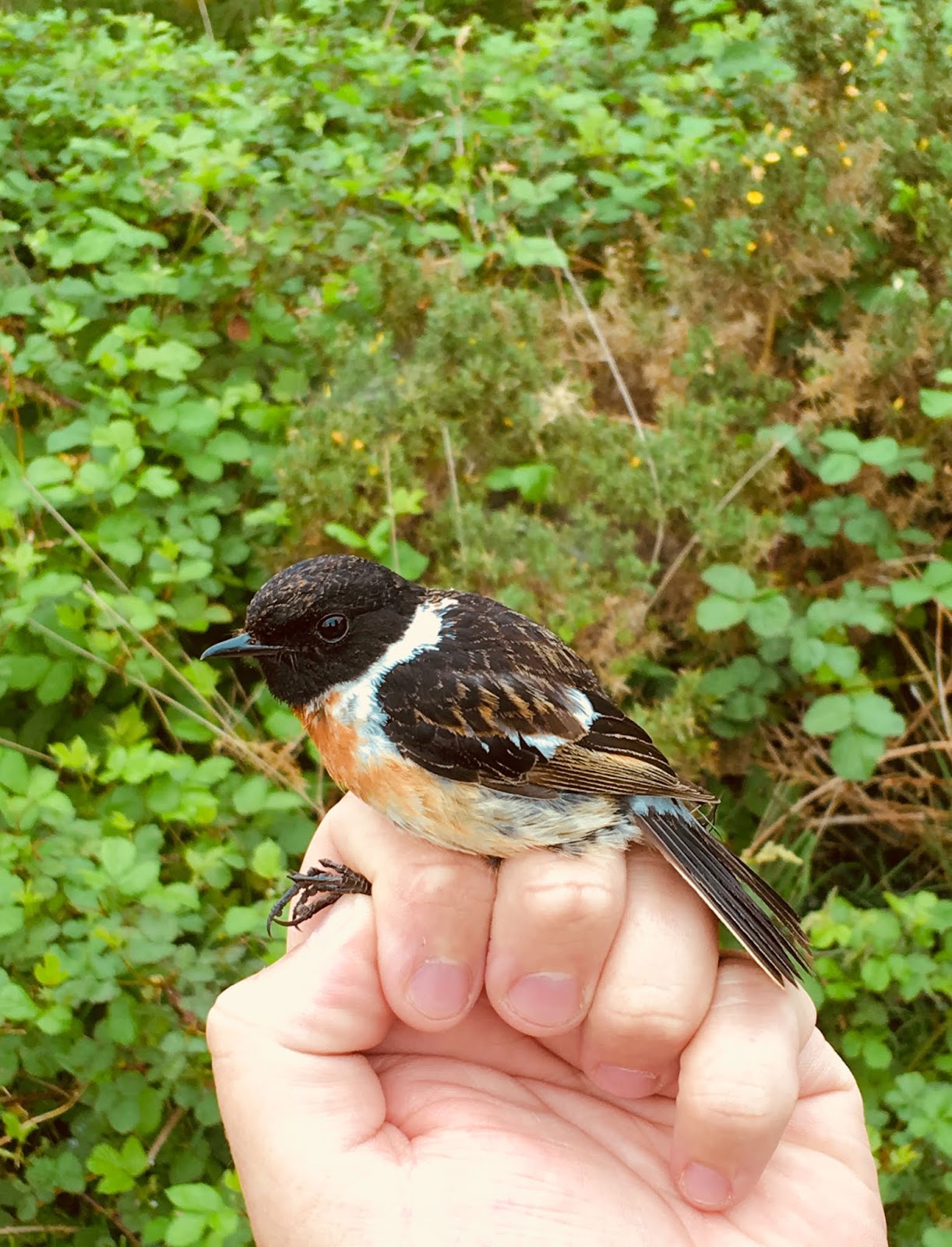
This smart male Stonechat survived the cold winter and went on to breed successfully with one chick fledging and surviving into adulthood


The beginning of my training has been a real eye opener for me, learning to be a bird ringer takes a lot of commitment and is a tough skill to master! Rightfully there are a lot of measures put into place before you are allowed a permit of your own but there is no rush for me as every time I go out I learn something new or I become more confident when handling birds and understanding how to identify and age each species in the hand. It’s fair to say that apart from the sleep deprivation (I get up at 4:30am in the summer!) I am enjoying every minute of it!

This Great Spotted Woodpecker was brilliant to see up close, however it drilled a nice hole into my thumb as you can see on the picture!


I’d like to say a big thankyou to Kester Wilson, Pete Roseveare, Mark Grantham, Robbie Philips, Jake and John Ryan for all of their help and company of the last few months.

Saturday, 10 February 2018

Constant Effort Ringing in 2017

Sat here in the howling wind and rain pondering what to do and where to go, got me reminiscing about the summer months of last year and some of the avian joys that I encountered. Not least of which was some of the birds that I met whilst carrying out a newly formed CES study at Goss Moor, Cornwall. 

What is a CES? 


CES is a BTO led study and stands for Constant Effort Ringing. More information can be found here: www.bto.org/volunteer-surveys/ringing/surveys/ces

The CES Scheme uses catches from standardised mist-netting to monitor key aspects of the demography of 24 common breeding songbirds. Around 130 sites are monitored through the breeding season, with twelve standard visits between May and August. Changes in the total number of adults caught provides a measure of changing population size, whilst the proportion of young birds caught forms an index of breeding success. Re-traps of adult birds ringed in previous years are also used to estimate annual survival rates.

I had been ringing on the Goss for about 3 years and decided that, whilst my results were good and the data valuable, I wanted to make the study of more use long term. Setting up a CES seemed the best way to do this to achieve useful long term data on a local and national scale. I opted to use 7 nets spanning 380 ft, with my ringing station centred in the middle of them. This meant that I could extract and process birds in a timely manner and let them on their merry way straight after. After talking with the wardens from Natural England I opted for this location as I knew from previous ringing sessions that there were Willow Tit in the area and both the BTO and Natural England both valued data on this declining species. It was also a good area for general Warbler populations and I was especially interested in studying Garden Warbler which is prolific on the Moor and is one of the few locations in Cornwall were the population is dense.   

Goss Moor is a 480 hectare National Nature Reserve (NNR) which is owned and managed by Natural England.

The Results 


8th of May

A selection of the first birds ringed on the newly formed CES

I was pleased with my first visit and processed more than I was expecting as species can be quite elusive at this time of year.

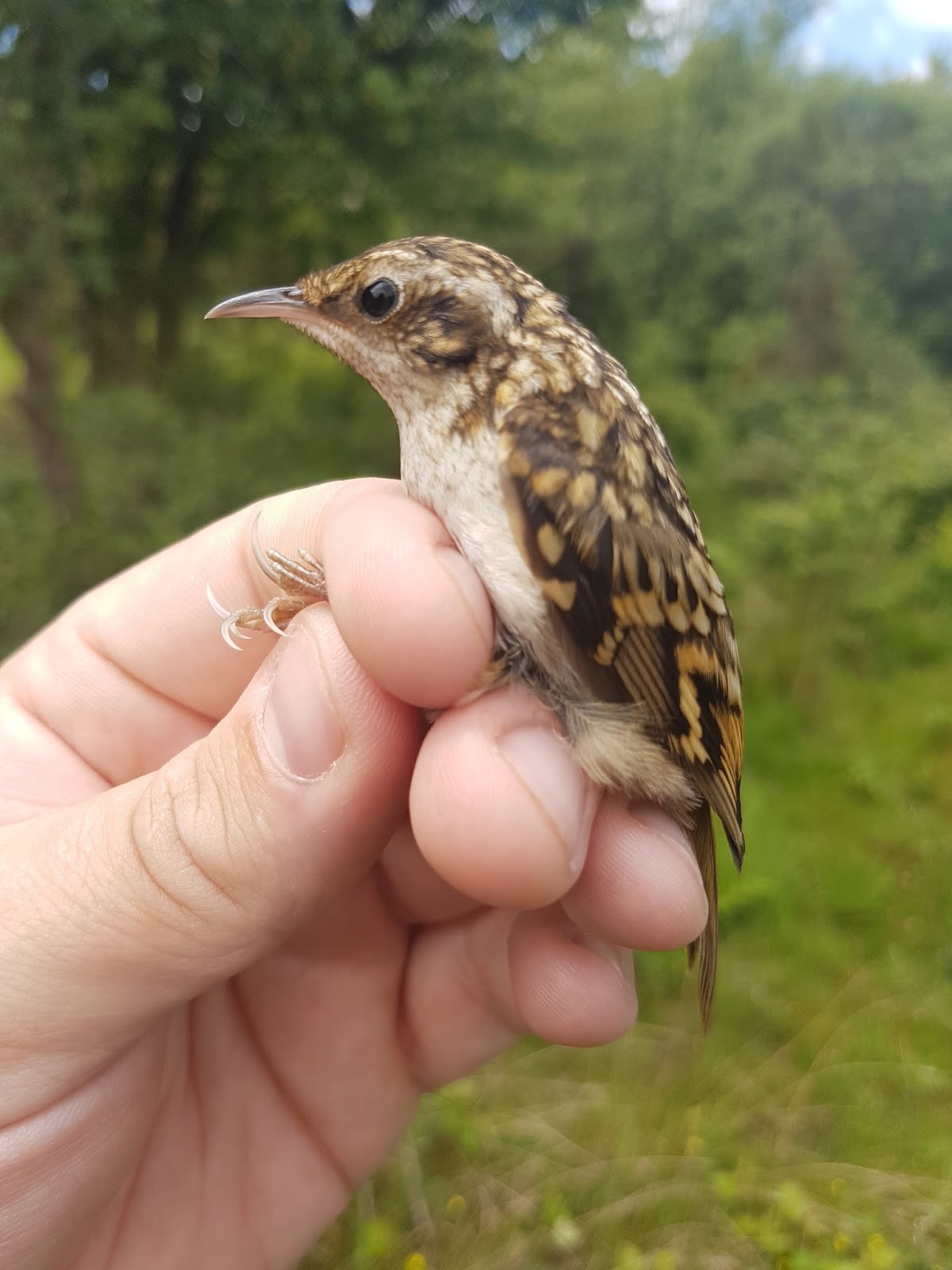
Long-tailed Tit x 2, Blackbird x 3, Willow Warbler x 6, Treecreeper x 2, Reed Bunting x 2, Goldcrest x 1, Garden Warbler x 1, Dunnock x 1, Chiffchaff x 3, Bullfinch x 3, Blackcap x 1, Robin x 3 and a Willow Tit.

Total = 29

18th of May

Slightly quieter as birds begin to settle on nests and are generally less active before young birds hatch. 

Robin x 1, Goldcrest x 1, Willow Tit x 1, Long-tailed Tit x 1, Chiffchaff x 1, Blackcap x 2, Bullfinch x 4, Willow Warbler x 6 and Garden Warbler x 3.

Total = 20

29th of May

This visit saw the first fledged young on the wing. All juvenile birds will be shown in brackets.

Garden Warbler x 4, Wren x 1 (1), Willow Warbler x 5, Song Thrush x 1, Robin x 2 (6), Goldcrest x 2, Dunnock x 1, Chaffinch x 3, Bullfinch x 4, Blue Tit x 2, Blackcap x 4 (1), Blackbird x 1, Long-tailed Tit x 2 (8).  

Total = 48

4th of June

Lovely to see recently fledged young out on the wing

Perhaps a bit too soon since my last visit but my circumstances dictated when I could carry out the session.

Long-tailed Tit x 1 (1), Bullfinch x 3, Wren x 1, Willow Warbler x 2, Treecreeper x 1 (2), Robin x 4 (1), Blackbird x (1), Chaffinch x 1, Chiffchaff x (2), Blackcap x (1) and a single Garden Warbler.

Total = 23

18th of June

Juvenile birds were starting to become much denser in this visit and made up over 50% of the birds processed.

Willow Warbler 5 (2), Wren (1), Robin 1 (6), Long-tailed Tit (1), Great Tit (1), Goldcrest 1, Chiffchaff (1), Chaffinch 1, Bullfinch 2, Blue Tit 1 (3), Blackcap 2 (7), Blackbird 1 (1), Garden Warbler (2).

Total = 39

1st of July 

61 juveniles were caught in this visit and seen large flocks of tits starting to flock together and rove around the Moor. 

Coal Tit 2 (8), Willow Warbler 5 (8), Robin 1 (2), Marsh Tit 1 (1), Long-tailed Tit 5 (12), Great Tit (10), Goldcrest 1, Blackcap 3 (3), Dunnock 2 (1), Chiffchaff 2 (4), Bullfinch 5, Blue Tit 2 (8), Garden Warbler (3).

Total = 90 

9th of July

This session saw the largest catch of the year with over 80% of the catch juvenile birds. 

Coal Tit (5), Blackcap 5 (49), Blue Tit 2 (8), Chiffchaff 2 (12), Swallow 1 (3), Bullfinch 7, Willow Warbler 5 (6), Robin (6), Long-tailed Tit (3), Great Tit 2 (4), Goldcrest (2), Garden Warbler (6), Dunnock (2), Wren 1 (10).

Total = 141

17th of July

The first juvenile Willow Tit of the year

Whilst not such a large catch as the last session over 90 % were juveniles during this visit.

Robin 1 (2), Dunnock (3), Wren (4), Willow Tit (1), Long-tailed Tit (1), Great Tit (1), Garden Warbler (6), Chiffchaff (3), Chaffinch (2), Bullfinch 5 (4), Blackbird (1), Blue Tit (3), Blackcap 1 (36), Coal Tit (4), Willow Warbler 2 (5).

Total = 85 

31st of July

Two more juvenile Willow Tits during session 9

Still a good session but had got quieter compared to the last few visits.

Coal Tit (2), Willow Warbler (6), Willow Tit (2), Robin (2), Great Tit 1 (4), Goldcrest 1, Dunnock 1 (1), Chiffchaff (5), Bullfinch 2, Blue Tit 1 (3), Blackcap 1 (6), Wren (2), Garden Warbler (1).

Total = 41

6th of August

Lotti (8), Willow Warbler 2 (5), Treecreeper (1), Sedge Warbler (2), Robin (4), Marsh Tit (1), Garden Warbler 1 (1), Dunnock (2), Coal Tit (2), Chiffchaff 1 (3), Blackcap 2 (4), Blue Tit 2 (3), Goldcrest 1 (2).

Total = 47 

20th of August


Nice to get to see a Tree Pipit up close and personal

Robin (4), Wren (1), Willow Warbler 1 (1), Tree Pipit (1), Sedge Warbler 1, Jay (1), Garden Warbler (2), Coal Tit (3), Chiffchaff (4), Bullfinch (3), Blue Tit 1 (2), Blackcap 1 (8), Great Tit (1), Swallow 1 (1).

Total = 37

28th of August

Goss Moor harbours good numbers of Bullfinch throughout the year
Blackbird (1), Marsh Tit (1), Long-tailed Tit 3, Great Tit 1 (3), Goldcrest 3 (3), Dunnock (1), Coal Tit (2), Chaffinch (1), Blue Tit (13), Robin (1), Bullfinch (3). 

Total = 36

A grand total of 636 birds processed which I was most pleased with. I hope that 2018 is another successful year for the breeding birds on the Goss Moor. 


Tuesday, 31 October 2017

Nanjizal Ringing and Year listing mop up!

Yesterday Bob and I returned to West Cornwall for a spot of Ringing and Viz Migging at Nanjizal and then a jaunt around West Cornwall to see what else was on offer.

It was exciting arriving at Nanjizal shortly after dawn as it was apparent from the outset that there were birds about. Pigeon's and Thrushes could be seen and heard piling through overhead along with a good number of Siskin. We joined Kester, John, Robbie and Jake, the later two from Falmouth University. They were hoping to catch up with some Yellow-browed Warblers and Chiffchaff's as part of a study that they were conducting on the origin and movements of each species  After the first net round I was pleased to see that there were also a good number of grounded migrants to process and record and that Chiffchaff seemed to be numerous and a Yellow-browed was bagged ready for Robbie and Jake to carry out their study work. Everyone was happy! 

The morning was just stunning with clear blue sky's and little wind. The birds overhead were passing through in phenomenal numbers and it seemed like the Wood Pigeon's were replacing the clouds as large flocks filled the sky over the valley. It was hard to take it all in as I had to concentrate at the birds in hand, thankfully Bob got in touch with his feminine side and managed to multi task by scribing for the four of us and keep an eye on the passing birds!   

The morning ended with 185 birds ringed! An incredible 51 Chiffchaff, 25 Goldcrest, 6 Firecrest (this will bring the Nanjizal autumn total near to 200!), 2 Yellow-browed Warbler. 11 Blackcap, 3 Cetti's Warbler, 20 Siskin, 1 Lesser Redpoll, 1 Reed Bunting, 2 Redwing and a single Brambling (this happened to be a long overdue ringing tick for me). Viz Mig records consisted of 4 Fieldfare, 4 Songthrush, 13 Redwing, 2619 Woodpigeon!, 56 Stock Dove, 1 Green Sandpiper, 84 Siskin, 1 Lesser Redpoll, 2 Common Snipe, 253 Golden Plover, 25 Lapwing, 2 Brambling, 1 Little Egret, 1 Kingfisher and 5 Swallows.

An incredible autumn for Firecrest's with many ringing stations processing unprecedented numbers!
It's not often that you get to appreciate the delicate structure of a Cetti's Warbler in Cornwall.


Siskin's could also seen in good numbers and 84 were recorded during the morning.
It was pleasing to see a Reed Bunting also moving through the valley.

Only a single Lesser Redpoll graced the nets, which was most welcome!

My bird of the morning came in the guise of this first year male Brambling! 
After the successful morning we plotted our route and were hopeful of picking up some lingering birds for the year list and we had also received some news that a Red-breasted Flycatcher had turned up at Kenidjack! 

Our first stop was Sennen were we were hopeful of encountering the Richard's Pipits that had been found a few days before. We set off and trudged our way around the grassy fields. I must admit I was finding this a slog after stomping around Nanjizal for the morning! I knew that the only way to get this bird secured on the year list was to knuckle down and drag my fat ass onward. This is always made even more difficult as I am always trying to keep up with lanky git (Bob) who musters one stride to two of mine! Thank god it paid off and 10 minutes in we heard the familiar "sneezey" call coming from the adjacent field as it took up from some rough ground very near to us. Whilst in the area we also recorded singles of Dunlin, Snipe and 2 Siskin. Thankful for the reward of our effort we headed for Kenidjack to try for the Red-breasted Flycatcher!

After a brief pit stop at St Just were I stocked up on energy drink and my all time stamina boosting secret, a Cornish Pasty, we made our way to Kenidjack and spotted a group of binocular clad chaps peering into a group of trees by the engine sheds. We parked the car and made our way to them. I was slightly disappointed to learn that they had not seen the Flycatcher but the finder was reliable and was told it was worth sticking it out. To be honest with you I would have anyway as the habitat is fantastic and right up my street! After a few minutes adjusting my eyes under the canopy of the mature trees Chiffchaff's and Crests were soon starting to materialise. A call went out that the Flycatcher was showing and I managed a clear but brief view as it flitted around in the distant vegetation. After awhile of waiting for it to show again my attention waned and went back to my new favourite stone wall bum perch. From here I had a good view and a flock of Long-tailed Tits added to the excitement bringing with them a Yellow-browed Warbler and a couple of Firecrest. Bob was muttering under his breath and when asked "what was up" he replied "I may have just had a couple of Hawfinch fly past but couldn't really nail them through the canopy foliage" or certainly words to that effect minus a few expletives! A Brambling settled on the tree canopy above us and started screaming in true Brambling style! The Flycatcher materialised again seemingly out of thin air and shortly after disintegrated into the foliage once again. We were both delighted to see the bird as it was one that we had hoped for all autumn and although views were not great it still left a satisfying memory in my mind! 

Our next stop was Drift where we knew a pair of Whopper Swan's had shown up the day before. Whilst talking to the locals at the Flycatcher twitch we were also informed that a Greenland White-fronted Goose was also present! Boom double whammy, we needed to get there before anything sinister happened and we dipped out. Thankfully we made it despite following Bob's gut instinct and taking a back road route. (Bob's sense of direction is sketchy and I often go the opposite way to his suggestion and find it was the right call to do so)! Both species were very obliging and we scoped them from the lay by gateway that overlooks the northern arm. We also observed a Kingfisher and 23 Stock Dove at the Reservoir.

If you are anywhere near Marazion at dusk I cannot recommend enough taking some time out and enjoying this natural spectacle!
We finished the day at Marazion Marsh as the sun set over Mounts Bay. Secretly I was hoping that a Great White Egret would show up as I need it for the year and it would be one that I would catch Bob up on as I was too busy ringing earlier in the year when an individual settled at Helston and Stithian's.  Alas no such luck, but you cannot go away disappointed with Marazion at this time of year as thousand's of Starlings gather in a flock and contort into beautiful murmurations just meters above the car park! What a spectacle to end a magnificent and successful day on and one that will stay in my memory for sometime to come.